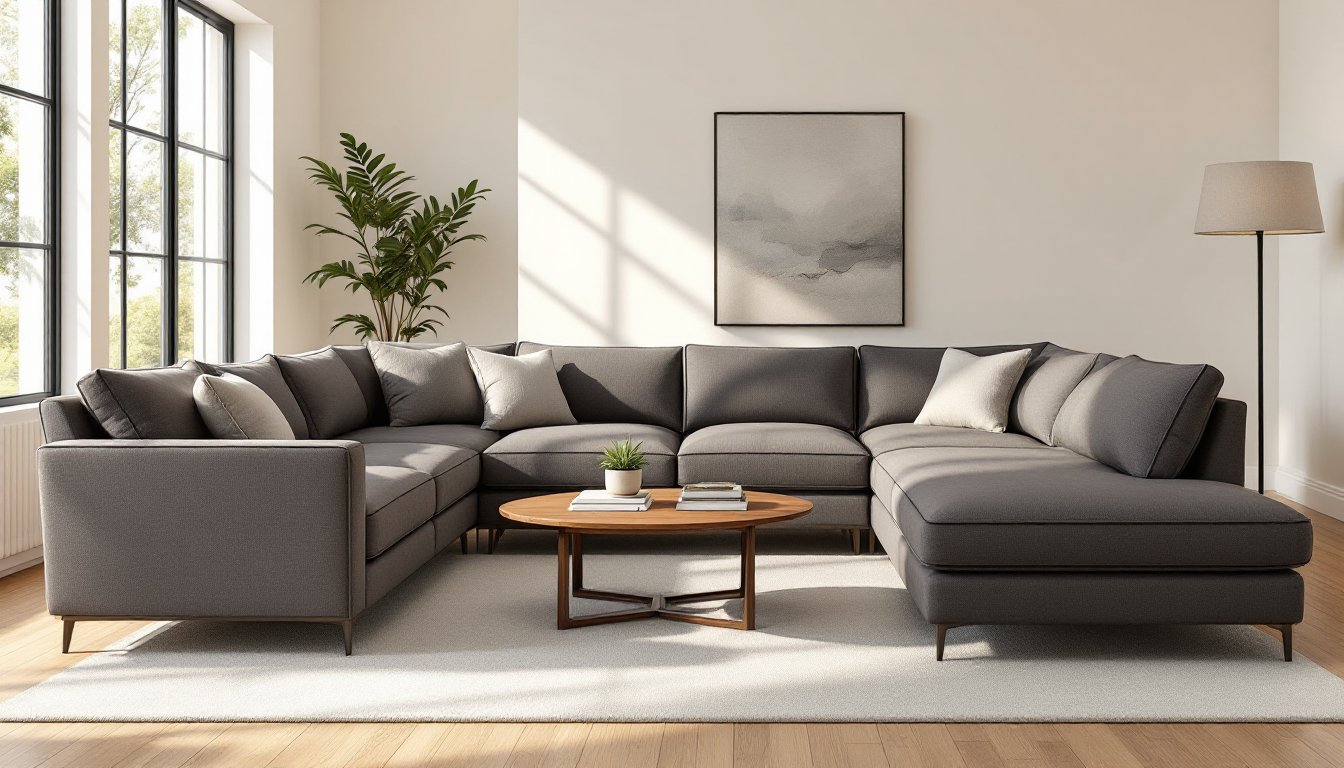
A U shaped sectional sofa can anchor a living room like no other furniture piece, offering seating for eight or more while defining the room’s layout and flow. But choosing one isn’t as simple as picking a color and clicking “buy.” These sofas demand careful planning, most measure 10 to 14 feet on each side, they’re rarely returnable, and a bad fit can make a spacious room feel like a furniture warehouse. This guide walks through the practical considerations: measuring doorways and corners, selecting durable upholstery that holds up to pets and kids, understanding modular versus fixed configurations, and arranging the piece so it complements rather than overwhelms the space.
Table of Contents
ToggleKey Takeaways
- A U shaped sectional sofa seats six to ten people comfortably and occupies 100 to 150 square feet, making it ideal for large families and open-concept living spaces where room definition is needed.
- Measure doorways, hallways, and ceiling height before purchasing—individual pieces can be 40 to 50 inches wide, and tight turns cause more delivery failures than standard doorways.
- Choose performance fabrics rated 30,000+ double rubs for durability, or opt for kiln-dried hardwood frames with eight-way hand-tied coils if you have kids and pets.
- Decide between modular configurations (flexible, easier delivery) and fixed-frame designs (sturdier, seamless look) based on your layout needs and future adaptability.
- Float your U shaped sectional away from walls with at least 12 to 18 inches clearance, position the open end toward your focal point, and anchor the space with a large area rug to define the conversation zone.
- Layer three to five pillows per section with vertical elements like artwork and floor lamps to prevent the room from feeling bottom-heavy or cramped.
What Is a U Shaped Sectional Sofa and Why Choose One?
A U shaped sectional sofa consists of three connected seating segments that form a U when viewed from above. The configuration typically includes two arms at the ends, a center section opposite them, and corner pieces linking all three sides. Most designs seat six to ten people comfortably, depending on depth and overall dimensions.
These sofas work best in larger living rooms, finished basements, or open-concept spaces where the piece can float away from walls. They create a natural conversation zone and can visually separate a living area from adjacent dining or kitchen spaces without requiring room dividers. Unlike L-shaped sectionals, the U shape offers seating on three sides, which makes it ideal for families who gather for movie nights or households that frequently host guests.
The trade-off is size and commitment. A standard U shaped sectional occupies roughly 100 to 150 square feet of floor space. Once delivered and assembled, moving or reconfiguring it often requires disassembling modular sections or hiring professional movers. That permanence means getting the initial placement and style choice right is critical.
Key Benefits of U Shaped Sectional Sofas for Your Home
Seating capacity is the primary draw. A full U configuration provides room for extended family during holidays, game-day crowds, or kids’ sleepovers without dragging in folding chairs. Many models include a chaise extension on one or both ends, giving lounging options that standard sofas can’t match.
Room definition comes naturally with a U shape. In open-floor plans, the sofa acts as a soft boundary, signaling where the living zone begins without blocking sightlines. Placing the open end of the U toward a focal point, like a fireplace, TV, or picture window, creates an intuitive traffic pattern and keeps foot traffic from cutting through the seating area.
Built-in versatility is another advantage. Modular U shaped sectionals let homeowners rearrange pieces as needs change. Remove a corner wedge and the sofa becomes an L-shape for a smaller room. Swap the chaise from left to right when rearranging furniture. Fixed-frame designs don’t offer that flexibility but often cost less and provide sturdier construction.
Many contemporary designs featured in roundups of best U-shaped sectionals also include hidden storage in ottomans or under-seat compartments, maximizing function in rooms where space is at a premium.
How to Measure Your Space for a U Shaped Sectional
Start by measuring the clear floor area where the sofa will sit. Use a tape measure to record length and width, then subtract at least 30 inches on all sides for walkways. Building codes and interior design standards recommend a minimum clearance of 30 to 36 inches for primary traffic paths, though 24 inches can work for secondary routes.
Next, check doorways, hallways, and stairwells. Most U shaped sectionals ship in multiple boxes, but individual pieces can still measure 40 to 50 inches wide and 36 to 42 inches deep. Measure door frames at their narrowest point (usually the casing, not the door itself). If a hallway turns sharply or stairs have a landing, measure diagonal clearance, many delivery failures happen at tight turns, not doorways.
Ceiling height matters if the sofa has high backs or if you’re moving it into a basement with low joists. Measure from floor to the lowest obstruction (ductwork, beams, or ceiling tiles). Standard sofa backs run 32 to 38 inches tall, but oversized models can reach 42 inches.
Before committing, map the footprint using painter’s tape on the floor. Include the sofa’s depth, often 38 to 45 inches, and any reclining mechanisms that add another 12 to 18 inches when extended. Walk the taped outline for a few days to ensure it doesn’t cramp movement or block access to windows, outlets, or HVAC vents.
Choosing the Right Fabric and Material for Durability
Performance fabrics are the workhorse option for households with kids, pets, or heavy use. Look for textiles rated 30,000 double rubs or higher on the Wyzenbeek abrasion test, that’s the industry benchmark for commercial-grade durability. Brands often use proprietary treatments (like Crypton or Sunbrella) that repel spills and resist staining. These fabrics clean easily with mild soap and water, and many are bleach-cleanable.
Leather and faux leather offer a different set of benefits. Top-grain leather develops a patina over time and can last decades if conditioned annually, but it scratches more easily than fabric and feels cold in winter, hot in summer. Bonded leather, made from leather scraps bonded with polyurethane, looks similar at first but peels and cracks after a few years. Faux leather (polyurethane or PVC) is budget-friendly and animal-free, but expect a lifespan of 5 to 7 years before visible wear.
Microfiber and velvet have gained popularity in modern design-forward interiors for their texture and color depth. Microfiber resists water and cleans well, though it can pill with heavy friction. Velvet adds luxury but requires professional cleaning for most spills and shows wear patterns (crushed nap) in high-contact areas.
Frame material is just as important as upholstery. Kiln-dried hardwood frames, typically oak, maple, or birch, resist warping and support weight evenly across joinery. Avoid frames made entirely of particleboard or softwoods like pine unless the sofa is lightly used. Quality construction uses corner blocks, double-doweled joints, and sinuous springs (S-springs) or eight-way hand-tied coils for the seat deck.
Design Styles and Configuration Options to Consider
Modular versus fixed-frame is the first decision. Modular U shaped sectionals consist of individual pieces, armless chairs, corner wedges, ottomans, that clip or hook together. This flexibility allows reconfiguration, easier delivery through tight spaces, and the option to add or remove sections later. Fixed-frame designs are built as two or three large pieces, offering a seamless look and often sturdier construction, but they’re harder to move and can’t adapt to layout changes.
Chaise placement affects how people use the sofa. A left-arm chaise (chaise on the left when facing the sofa) works well if you want to stretch out while watching a TV mounted on the right wall. Reversible chaises or models with dual chaises on both ends accommodate multiple loungers. Some configurations include a center chaise or armless loveseat, creating a more symmetrical profile.
Arm styles influence both aesthetics and seat width. Track arms (straight, boxy) maximize seating space and suit contemporary or minimalist rooms. Rolled arms add traditional charm but consume an extra 4 to 6 inches per side. English arms (low and rounded) work in transitional designs but offer less head support for side-sitters.
Seat depth and cushion fill determine comfort over long periods. Standard seat depth runs 20 to 24 inches, but deeper models (26 to 30 inches) let people sit cross-legged or curl up. High-resilience foam (HR foam, density 2.0 lb/ft³ or higher) holds its shape better than standard polyfoam. Down-wrapped foam cores combine the structure of foam with the softness of feather fill, though they require regular fluffing. For inspiration on integrating sectionals into broader home decor plans, consider how cushion style, tight-back versus loose pillow-back, affects the room’s formality and maintenance needs.
Arranging and Styling Your U Shaped Sectional for Maximum Impact
Floating the sofa away from walls creates a more sophisticated layout and improves traffic flow. Position the open end of the U toward the room’s focal point, fireplace, entertainment center, or picture window. Leave at least 12 to 18 inches between the sofa back and the wall to avoid a cramped look and allow access for cleaning or adjusting pillows.
Anchor with an area rug that extends 12 to 18 inches beyond the front edge of the sofa on all sides. This visually unifies the seating area and defines the conversation zone. In large rooms, the rug should be large enough that all front legs of the sectional rest on it: in smaller spaces, just the front legs touching the rug works.
Add a coffee table or ottoman in the center, keeping it roughly two-thirds the length of the sofa’s longest side and 14 to 18 inches from the seat edge. Oval or round tables prevent sharp corners in a tight U layout. Nesting tables or C-shaped side tables offer flexible surface space without blocking movement.
Balance with vertical elements to prevent the room from feeling bottom-heavy. Hang artwork, mirrors, or shelving on the wall behind the sofa’s open side. Floor lamps at the corners provide task lighting for reading and add height. Avoid placing tall furniture (bookcases, cabinets) inside the U, it blocks sightlines and makes the space feel closed off.
Layer textures and scale with throw pillows and blankets, but keep it restrained. Three to five pillows per section is enough: more creates clutter and eats into seating. Use lumbar pillows (12×20 inches) for lower-back support and larger Euro squares (24×24 inches) at the corners for a layered look.
Conclusion
A U shaped sectional sofa rewards careful planning with years of comfortable, versatile seating. Measure twice, doorways, room clearances, and traffic paths, before ordering. Prioritize durable frame construction and stain-resistant fabrics if the sofa will see daily use. Match the configuration to how the household actually lives: modular for flexibility, fixed-frame for a tailored look, chaises where people lounge most. With the right fit and thoughtful styling, a well-chosen U sectional becomes the room’s anchor, not its obstacle.